I have lived with myasthenia gravis for over thirty years. This is my MG story.
It began when I was in college. I was at Bentley University in Waltham, Massachusetts, and I was just about to turn 21. I started feeling something strange around my mouth, and I had a hard time chewing. I remember trying to eat a steak at campus dining and couldn’t chew it. While I was eating cereal, I couldn’t fully close my mouth – milk was dribbling out.
I was working at the university on the phone bank, and one night while I was on the phone with someone, I couldn’t talk. I was due to get my wisdom teeth out, so I thought it was connected to that. None of it made sense.
I woke up on my birthday – it was January 1993 – and I was seeing double.
I wasn’t sure what was going on. My mother, who was a nurse, called the eye doctor. I got an appointment that day, and he knew right away it was not an eye issue but a neurology issue. He first brought up myasthenia gravis. My mom ran home and looked it up in her medical book.
We followed up with my primary care doctor, who did not totally believe that it was myasthenia gravis, but he agreed to send me to a neurologist. The neurologist did some tests, and by the end of the month, it was confirmed that I had MG.
I feel very lucky to have had my MG diagnosed so early; I’ve heard horror stories where people don’t get diagnosed for years.
I had a scan, which confirmed I had a tumor on my thymus gland, and I was referred to a specialist in Boston for a thymectomy.
In the meantime, I was being treated with Mestinon, but I had constant double vision. I didn’t have many other symptoms – sometimes, my arms might get a little tired, but overall, I was able to get by.
By mid-March, I had my thymectomy, and I returned to school. There I was, a 21-year-old, not really sure what I was dealing with. I thought I’d be fine.
I will never forget an experience I had that spring. My dorm room was at the top of this long stair – it must have been 100 stairs tall. I was in great shape before my diagnosis, always active. I had no problem bounding up those stairs. But after the diagnosis and my surgery…
It was a rainy day. I was heading up those stairs. I got maybe 20 stairs with my backpack and my umbrella, and I just collapsed. My legs just stopped working. Another student saw me, came running, and helped me up the rest of the way.
This was my transition from ocular symptoms to generalized MG.
From that point on, over the next two months, I was in and out of the hospital. I would receive IVIG treatment on an in-patient basis, and it helped. I was on high-dose prednisone. I continued to take Mestinon, but it was not working well for me. I tried Cyclosporin but couldn’t tolerate the side effects.
I had to adapt to continue with school. I had to get a dorm that was closer to the classrooms and reduce my course load. I had a handicapped placard, so when my parents drove me, it was easier to get places. My professors were able to give me books on tape. In the end, it took me an extra year to graduate. My face in all my pictures was the round prednisone face.
Being sick – it consumes your life. I was a college student. I was supposed to party! It changed everything. I couldn’t go out. I was exhausted. You’re just trying to live your life. You’re just trying to do everything you did before. I remember asking my mother when I could do aerobics again. She didn’t have an answer for me.
In college, I found the local chapter of the MGFA support group. That was a game changer. I ended up being the secretary. I was the youngest in the group, by far, but I had validation for so many of my feelings. I remember talking to one group member around my age who acknowledged that it’s hard. MG just stops you in your tracks.
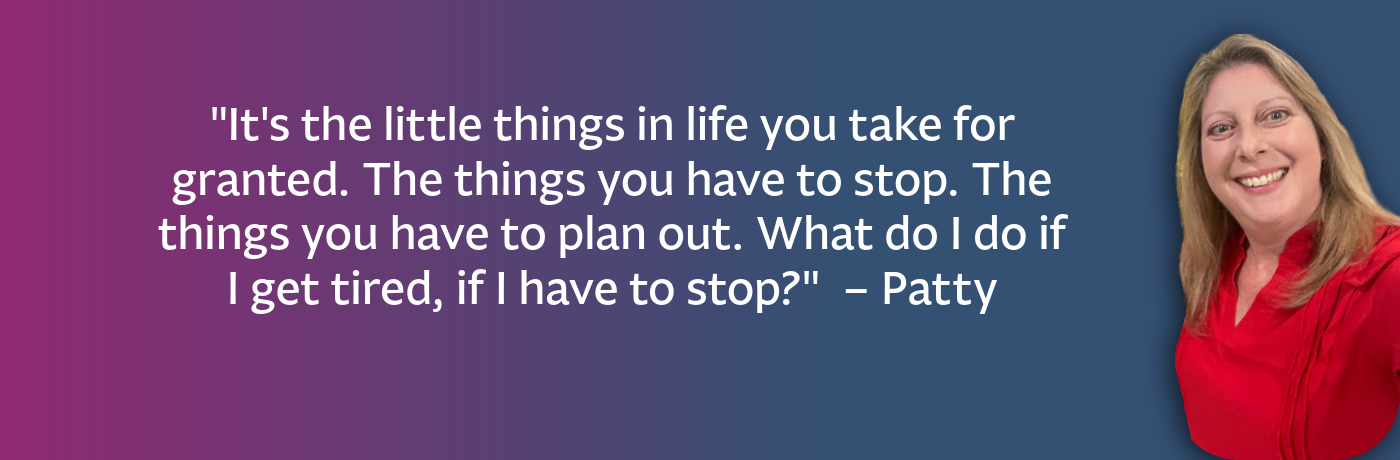
The worst is when you’re in the middle of shampooing your hair, and you have to stop because you can’t hold your arms up. It’s the little things. The little things in life you take for granted. The things you have to stop. The things you have to plan out. What do I do if I get tired, if I have to stop? Can I get a ride home? Will there be folks there who know me, who can help if something happens?
I found that IVIG treatment was gold for me – that’s what would work. Nurses would come to me at my house or my dorm room to give me my infusion. I was “that person” – the roommate hooked up to the IV pole! My dad used to call it “go-go” juice. I would get it and I would feel like myself again. It was like my miracle.
I was on IVIG for close to 10 years, once every month.
After I graduated, I went to work in the human resources field. Once a month, for five days, I would have to leave early for my treatment. Fortunately, my employer gave me the accommodation.
After years of this, my neurologist decided to bump me down to four days of IVIG treatment, every five weeks. Eventually, it was three days every six weeks. I was feeling great. He said, “Why don’t we just stop it?” I was game. I know all the symptoms, so I knew what to look for if his plan wasn’t working.
Ten years post-thymectomy, I went into full remission. I was 31. That was 10 years living with symptoms. It was weird not to have them anymore. I had put in a port because I was getting so many IV treatments, and I had it removed. It felt amazing.
I went about my life, but I knew it could always come back. I am always careful. It has not yet come back.
I successfully had two babies. My OB was very nervous – she knew that I couldn’t have magnesium if I ended up with preeclampsia – but I had two successful deliveries and no recurrence of my MG. My husband doesn’t even know me with MG symptoms.
There are so many people out there who never go into remission – I felt a little guilty that I was one of the lucky ones.
MG consumed my life for 10 years, but when I went into remission, I was able to put MG on the back burner. I went on with the rest of my life. Now I’m in a different place in my life. I have two middle-schoolers, and I want to educate them about this disease. I want to educate people and to give back.
I’m excited that our family will join the MG Walk in Boston this year. We reconnected with the MGFA at a Worcester Railers hockey game, where we are season ticket holders. The MGFA happened to be the charity of the game one Thursday night in April. I do believe everything happens for a reason, and that was my cue to get back involved. I’m so excited that my story, my journey, can somehow help someone else.