By Mary Bolster
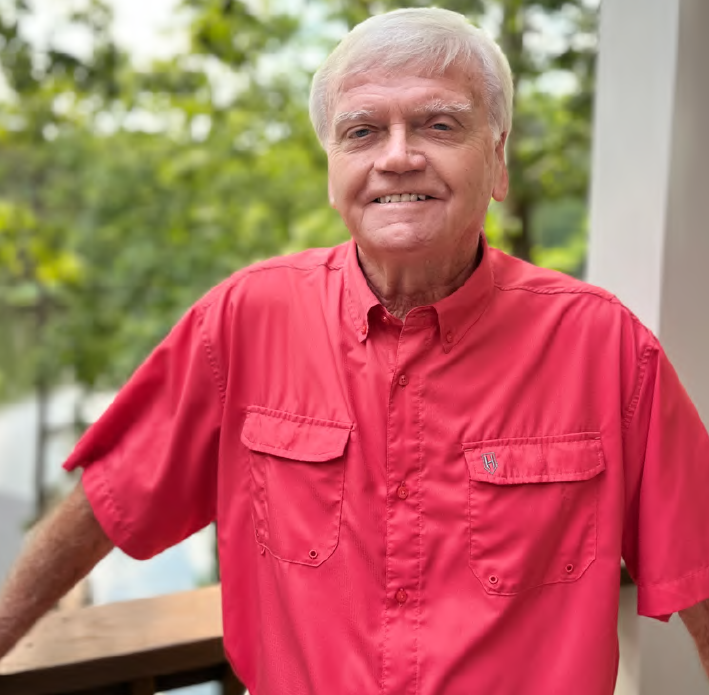
The symptoms were subtle at first. Moments of double vision. Occasional weakness in the legs and arms. When his symptoms escalated to trouble swallowing and shortness of breath, Danny DeBerry, a forestry worker in Troy, NC, consulted his primary care physician and was referred to local neurologists, who ordered blood tests and an MRI.
When the neurologists suspected myasthenia gravis, they sent DeBerry to James F. Howard, MD, Jr., an MG specialist at UNC School of Medicine in
Chapel Hill, NC, for a definitive diagnosis. After conducting a full examination and a muscle test, a breathing test, and a single-fiber electromyography test, Dr. Howard confirmed the diagnosis. The year was 2012 and DeBerry was 58.
Treatment started immediately. DeBerry was prescribed what he described as “massive doses” of prednisone a day (60 mg) and plasma exchanges every other day for 10 days.
“Seven bottles of plasma in, seven bottles out,” he recalls. “It would help but it didn’t solve the problem.” His double vision worsened, affecting his depth perception and his ability to guess distances.
“I kept bumping into things. It was really depressing.” He also was short of breath more often and with less exertion. “I couldn’t walk from my house to my truck without stopping to rest,” he says.
When several treatment options didn’t work, DeBerry began intravenous immunoglobulin (IVIG), an IV procedure in which antibodies are infused directly into the bloodstream. The treatments eased DeBerry’s symptoms “a little it,” but not enough to lift his depression.
Just a few days later, he was thumbing through the MGFA’s Focus on MG magazine and saw an article about a clinical trial recruiting people with MG. DeBerry, who is now 71, emailed straight away.
The trial organizers emailed back saying he was ineligible because of his age. Desperate, DeBerry emailed again.
“I told them I was in a bad way,” says DeBerry. As it turned out, Dr. Howard was running the trial and agreed to take his former patient.
The trial was testing an experimental therapy called CAR T-cell. Developed by oncology researchers, CAR T-cell has been used to treat certain blood cancers like lymphoma, says Christina Ulane, MD, associate professor of neurology at Columbia University Irving Medical Center.
“What we have learned from this research into b-cell cancers is that this treatment can be co-opted to treat autoimmune disorders like myasthenia gravis,” she says.
DeBerry has been enrolled in the trial for four years, and after each infusion, he has remained free of symptoms for 18 months, at which point he gets reinfused. Side effects from the treatment have been minimal: he usually spikes a fever three weeks after the infusion and once had to be hospitalized. He’s also noticed that his hair is fuller.
The best news: His life is his own again.
“I’ve gone from not being able to walk to my truck from the house to being able to work all day in the forest,” he says. “That beats lying in bed and getting seven bottles of plasma infused.”
The trial saved his life, DeBerry says.
“It I hadn’t come across this study I wouldn’t be here. I’m pretty much back to normal, or as normal as can be for an old man.”
Now he’s doing what he can to spread the news. A few years ago, a professor from New Jersey called DeBerry to ask about the trial.
“He was having some of the same problems I was having and wringing his hands over whether to join the trial,” DeBerry recalls. “I shared what the trial has meant to me. A little while later, the professor called me back to tell me he was on the golf course playing 18 holes.”
Mary Bolster is a freelance health journalist and former managing editor of Brain & Life magazine.